Child residence card photo in Poland: how to take it at home for MOS
Polish regulations have no separate photo rules for children, aside from one line allowing an open mouth or closed eyes when necessary. You can shoot a baby on a white sheet or a toddler against a plain wall on your phone, then file from your own MOS account.
A child's residence card photo in Poland follows the same technical specs as an adult's: a JPG of at least 684×883pixels, under 2.5 MB, taken within the last 6 months, with a plain light background and the face covering 70–80% of the height. The regulation on temporary residence applications (Dz.U. 2026 poz. 553) doesn't have a dedicated section for children. Instead, one line in the form instructions (pouczenie) states that in justified cases you may attach a photo with closed eyes, an open mouth, or a less than neutral expression. A baby who doesn't understand "look at the camera" clearly falls under that exception, and a regular phone camera at home is enough to get a valid shot.
What stays the same as for adults, and the one exception
The MOS portal runs the exact same automated checks on upload, and case officers at the urząd (voivodeship office) look for almost all the same details as on an adult photo. You still need the head from the crown to the top of the shoulders, a straight-on angle, eyes open and clear of hair, a closed mouth, and an eye line level with the top edge. The complete list, including rules for glasses and headwear, is in our MOS 2.0 photo requirements.
The only leeway is that single sentence in the form instructions, and it doesn't specify an age limit. Nothing on gov.pl or the MOS site lets a child tilt their head or look sideways, so it is safest to shoot assuming the officer will be strict.
Whatever the child's age, they must be alone in the frame. Official Polish guidance for passport photos of children under 5 explicitly bans other people, fingers, or objects from appearing in the shot, so if someone steadies the baby's head, their hand cannot show.
How to photograph a baby
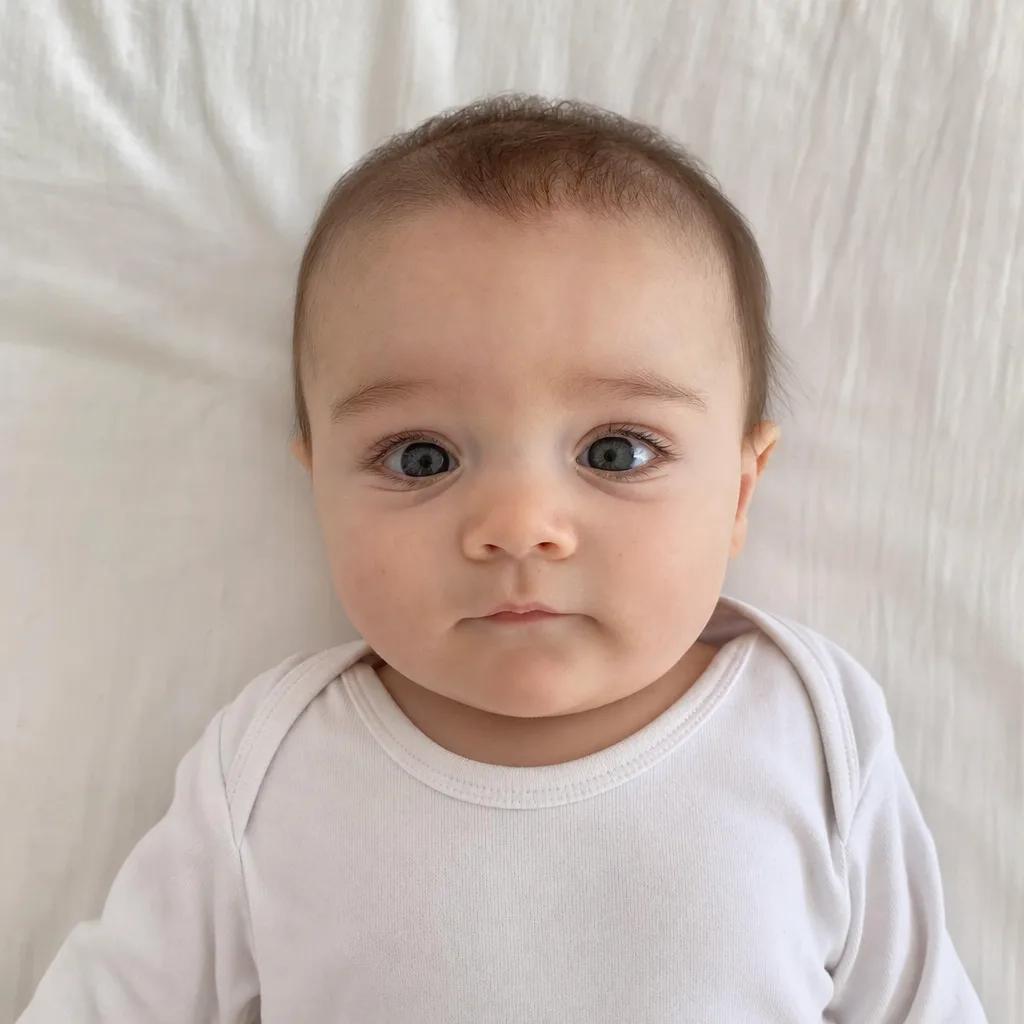
Spread a plain white sheet flat on a bed or the floor, lay your baby on their back, and hold your phone directly above their face, parallel to the floor. When an infant is lying flat, an overhead shot gives you the required straight-on angle, and the sheet acts as a plain background. Nothing in the rules requires a baby to sit upright.
- Shoot in daylight from a window to your side or behind you, and keep the flash off. Overhead ceiling lights usually cast shadows under the nose and chin.
- Pull the sheet smooth under the baby's head so creases don't turn into dark lines.
- Have a second adult stand right behind the phone holding a rattle or toy to draw the baby's gaze upward, keeping their hands well outside the frame.
- Hold down the shutter or use burst mode: out of twenty shots, you'll usually catch a couple where both eyes are open and the mouth is closed.
- Leave extra space above the head and below the shoulders so you have room to crop properly afterwards.
Toddlers, two to three years old
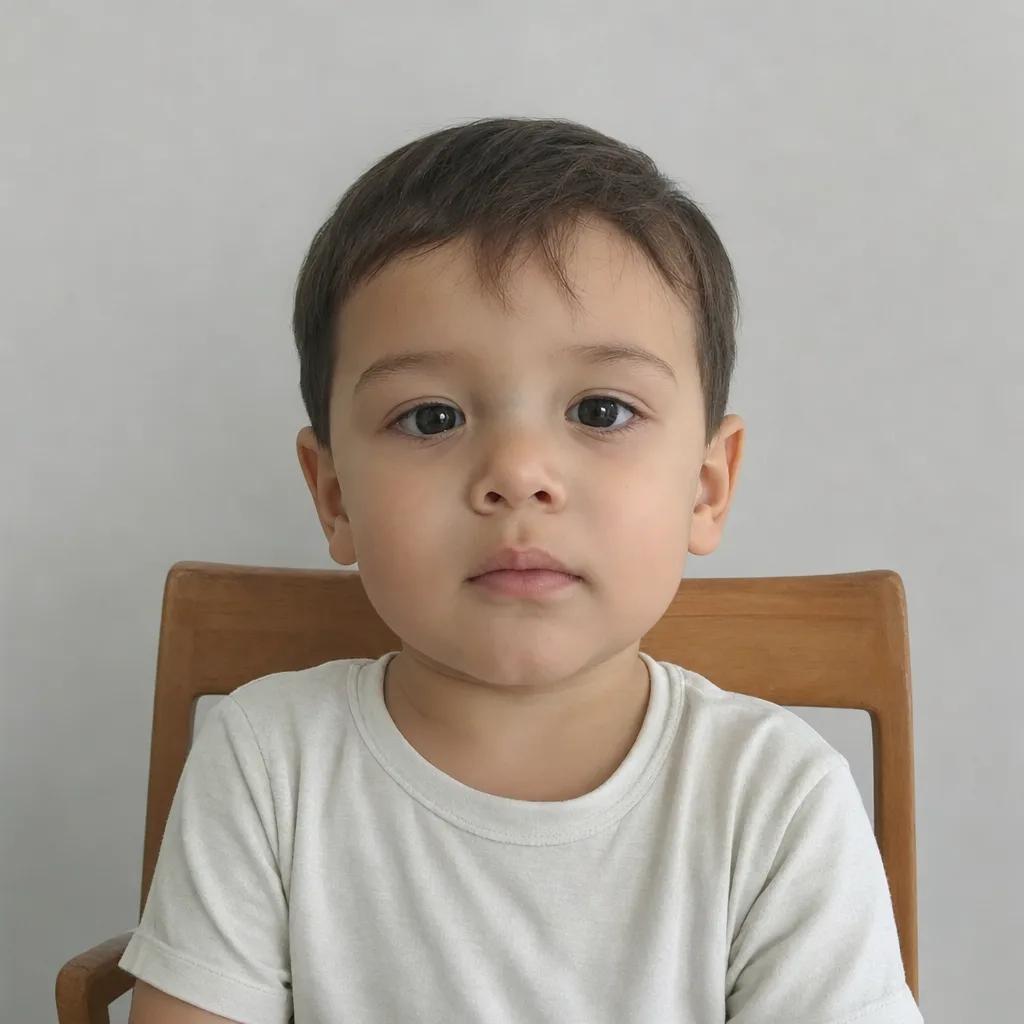
Seat your child on a chair about half a metre in front of a plain light wall, then crouch down so your phone is level with their eyes. Shooting down from standing height makes the head look too big and the shoulders narrow, which won't pass as a frontal portrait. Get someone to stand behind you with a toy just above the camera so your toddler looks straight into the lens. Ask for a serious face like on mum or dad's passport, take a quick burst of shots, and wrap up after a couple of minutes before they lose patience. For general lighting and camera setup, see our guide on how to take a karta pobytu photo at home.
School-age children
By school age, offices expect the same standard as for adults. A seven-year-old can usually manage a neutral expression with a closed mouth for a few seconds without smiling. Glasses can stay on as long as the eyes show clearly and there is no glare on the lenses.
What the mosfoto tool does with a child's photo
It handles a child's photo much the same way it handles an adult's. The tool finds the head, frames it so the face fills 70–80% of the height, crops the file to 684×883 pixels, and replaces the background with solid white so sheet wrinkles and wall shadows disappear. Then it checks that only one face is present, nothing clips the edges of the head, and the image isn't blurry.
Our automated check also estimates whether the child looks under five. When it sees a young child, it skips warnings for an open mouth, half-closed eyes, or a slight sideways glance, since the official instructions allow those exceptions. Even then, the case officer still makes the final call. If the shot was taken from too far away for automatic face detection, the manual crop editor opens so you can frame it yourself.
Why children's photos get rejected
- A parent's hand showing in the frame. Background removal cannot cleanly erase fingers gripping a baby's neck, and the rules forbid supporting hands anyway, so laying the baby flat is much more reliable.
- Shooting from too far away. If you crop a full-body picture down until the head fills 70–80% of the height, the face turns blurry. Frame from the chest or shoulders up.
- A turned or tilted head. The instructions forgive an open mouth, not a side profile or a crooked angle.
- A dummy, hat, or toy near the face. Nothing other than the child can be in the picture.
- Sending the file through a messaging app. Chat apps shrink and recompress photos, often dropping them below 684×883pixels, so always upload the original image from your phone's gallery.
Who files the application for a child in MOS 2.0
A parent submits the application from their own MOS account. According to the Office for Foreigners (UdSC) MOS Q&A, you can add a minor child's profile under your own login as long as you have a Profil Zaufany(Poland's free e-ID), and a parent or legal guardian signs on the child's behalf.
Log in, open Moje konto (my account), go to Dane osobowe (personal data), click Dodaj konto(add account), and enter your child's details. When you start a new application, the portal asks which person's profile to use. Each child needs a separate application, photo, and fee payment. If you haven't created your own account yet, start with registering in MOS 2.0.
For CUKR, a child born in Poland after 23 February 2022 qualifies if their PESEL holds UKR status both on the day you apply and on the day the card is issued, and if the mother already holds a CUKR card. The Lubuskie voivodeship office, for instance, asks for the birth certificate with a translation and doesn't require a passport, though your local office's checklist may differ. UdSC confirms that both CUKR fees (340 PLN and 100 PLN) apply in full to children too. A standard temporary residence permit is cheaper for minors: the card fee for a child under 16 is 50 PLN. Full fee details are in residence card fees in MOS 2.0; we also have a CUKR card step-by-step guide and a residence card photo guide for Poland for your own photo.
FAQ
Can a baby have an open mouth in a karta pobytu photo?
Yes, if needed. The form instructions allow closed eyes, an open mouth, or a non-neutral expression in justified cases, and a baby counts as one. A frame with a closed mouth is still the safer shot.
Can my hand holding the baby's head be in the photo?
No. Official Polish guidance for photos of children under 5 states that no other people, fingers, or objects may appear in the frame, so a supporting hand cannot be visible.
Can I use a newborn photo taken at the hospital?
Usually not. Even if it is under 6 months old, hospital photos almost always show a patterned blanket, a parent's hand, or a head turned to the side. Taking a fresh shot on a white sheet at home takes about ten minutes.
What file does MOS 2.0 accept for a child's photo?
The same format as for adults: a JPG of at least 684×883 pixels in 35×45 mm proportions, up to 2.5 MB, taken within the last 6 months.
Does my child need their own MOS account or Profil Zaufany?
No. You add your child's profile inside your own account under Dane osobowe (personal data) using Dodaj konto (add account), then file from your login. Only the parent needs a Profil Zaufany.
Is a residence card cheaper for a child?
Not for CUKR: both fees (340 PLN and 100 PLN) apply in full regardless of age. For a regular temporary residence permit, the card itself costs 50 PLN for a child under 16 instead of 100 PLN.
Sources
- Rozporządzenie MSWiA z 10 kwietnia 2026 r. w sprawie wniosku o udzielenie cudzoziemcowi zezwolenia na pobyt czasowy (Dz.U. 2026 poz. 553)
- UdSC: MOS, pytania i odpowiedzi
- Gov.pl: Zdjęcia do dokumentu paszportowego (wymogi dla dziecka do 5. roku życia)
- Śląski UW: CUKR, pytania i odpowiedzi
- Lubuski UW: Karta CUKR w kilku krokach